
 10 hours ago
11
10 hours ago
11
ARTICLE AD BOX
38 minutes ago
Paul KirbyEurope digital editor in Budapest

 Reuters
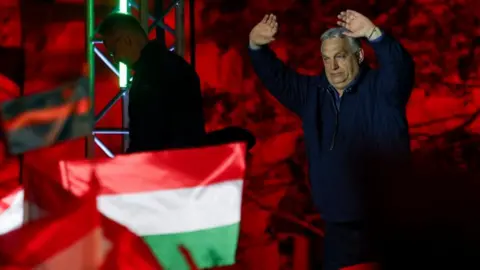
Viktor Orbán stuck with his familiar campaign themes ahead of the vote, attacking Brussels and Ukraine
Hungarians go to the polls on Sunday in a vote that could bring down long-serving Prime Minister Viktor Orbán and have significant repercussions for the rest of Europe, the US and Russia.
Most polls favour Péter Magyar, who formed a grassroots party after splitting from the ruling Fidesz party, but the night before the vote Orbán was in defiant mood.
"We are going to achieve such a victory that will surprise everyone, perhaps even ourselves," he told several thousand supporters in a small square on Budapest's Castle Hill.
Voting takes place from 06:00-19:00 (04:00-17:00 GMT) and results will start to come through during the evening.
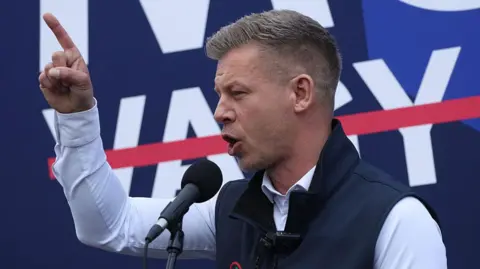
Orbán turned tensions up a notch ahead of the vote, claiming the opposition would "stop at nothing to seize power", and Magyar responded by appealing to voters not to give in to "Fidesz pressure and blackmail".
After 16 years of Orbán running Hungary with what the European Parliament termed a "hybrid regime of electoral autocracy", Magyar and his Tisza party are promising "a change of regime", a reset of relations with the European Union and an end to close relations with Russia.
He attracted far greater numbers to his final rally in the second city Debrecen than Orbán in Budapest.
But Orbán remains highly valued by US President Donald Trump, who has called on Hungarians to "get out and vote" for his "true friend, fighter, and WINNER".
Addressing supporters on Saturday night, the Fidesz leader kept to his main campaign themes of targeting Brussels and Ukraine. "We don't give our children, we don't give our weapons and we don't give our money," he said.
 Sean Gallup/Getty Images
Péter Magyar has appealed to voters not to be tempted to commit electoral fraud
His message resonated with the crowd, who chanted "we won't let that happen". One supporter, Johanna, said she backed his policies on protecting the family and particularly on the war in Ukraine.
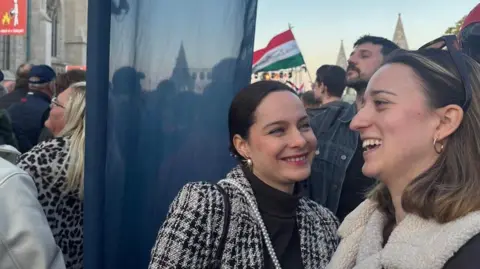
Veronika (L) and Johanna were optimistic Fidesz would win on Sunday
He has proved to be a winner four times in a row, but a fifth consecutive victory may be beyond his reach.
The economy is struggling, and he has been buffeted by a series of scandals, including revelations that Foreign Minister Péter Szijjártó regularly spoke to his Russian counterpart before and after European Union summits, which he has admitted.
Hungary is not just in the EU, it is in Nato too, but Orbán has vetoed €90bn (£78bn) in aid to Ukraine, angering his European partners.
Hungary's three most reliable pollsters are all pointing to a "huge lead" for Magyar's Tisza party, says election specialist Róbert László at Budapest think tank Political Capital. Most analysts had assumed Fidesz would reduce that lead as the election drew closer, but he says that has not happened.
Magyar has told voters they need not just an absolute majority of 100 seats in the 199-seat parliament, but a two-thirds super-majority, to wind back many of the constitutional changes that Fidesz made to the independence of the judiciary, ownership of the media, and many other walks of life. Hungary is repeatedly at the bottom of Transparency International's Corruption Perceptions Index.
"The most likely scenario is that Tisza will have a comfortable, absolute majority, but not a two-thirds majority. But you can't exclude a two-thirds majority either," says László.
In recent days, there have been figures from the police, military and business who have all spoken out against Fidesz, and László believes this is a sign that the public mood has turned against Orbán.
Hungary has a complicated electoral system:
- Of the 199 seats available, 106 are directly elected in constituencies
- The other 93 go to party lists for which Hungarians abroad as well as at home are allowed to vote
- In the constituency races, losing parties have their votes transferred to the national list
- Winning parties have excess votes transferred too, and that has often benefited Fidesz
- Parties need 5% of the national vote to get into parliament
Viktor Orbán has admitted the electoral system has benefited his party.
One of the few pollsters that suggests he can still win is Nézőpont Institute, whose head Ágoston Mráz points to 22 so-called "battleground seats" out of the total 106 constituencies. If Fidesz were to win those seats, he foresees a potential victory. However, as 5% of the votes in those seats will not be counted immediately, it could take several days for the final result to become clear.
He also argues that Fidesz voters may not be as loud as their Tisza counterparts.
"Conservative voters are not normally as enthusiastic or their self-confidence is probably limited. They are more hidden voters, they are not ready to answer questions of pollsters, and among the Fidesz voters there are more, in percentage, blue-collar voters than in the Tisza party voter camp."
 Reuters
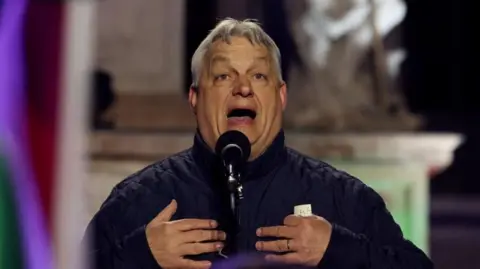
Orbán became rattled during a speech in late March when he was jeered by protesters
If Magyar is to win, Tisza will need to defeat Fidesz in some important towns and cities, not least Hungary's sixth-biggest city, Györ, close to the Slovak border in the north-west.
Orbán himself put Györ on the campaign map last month when he noticeably lost his cool towards booing protesters and accused them of "pushing Ukrainian interests".
Conversely, Magyar hosted a very large rally in a central square in Györ last Thursday.
Gergely Németh, a 20-year-old student who said he was going to the square with his mother, explained that as a family they had struggled financially because of government policy.
Although mothers with two or more children have increasingly become exempt from income tax under Orbán's pro-family policies, not everyone has benefited.
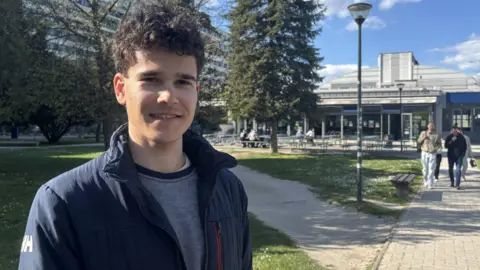
Student Gergely Németh says all the young people he knows want Fidesz out
Like many first-time voters who talked to the BBC, Németh said his main priority was defeating Fidesz: "I think it's not the man, Péter Magyar, who's most important. More important is that someone changes these politicians in the parliament."
For the past two years Györ has had an independent mayor and deputy mayor, but Fidesz still has a majority on the local council.
"I know what Fidesz brings, I know what Fidesz does, I live in it," says Deputy Mayor Roland Kósa, who speaks of an arrogance towards power. "When we got elected, what we faced even before and after is that Fidesz basically looked through us and said and thought we do not exist - this is still their city, this is still their country."

Roland Kósa, deputy mayor in Győr, says Fidesz squandered huge sums and years of opportunity in his city
Kósa believes that the right way to take on Fidesz has been by breaking out of party politics.
Although Magyar forged his political career as a centre-right conservative under Orbán, he dramatically turned on his party two years ago, and now attracts voters from across the political spectrum.
That has enabled voters who might not like him as a person to hold their noses in the knowledge that they are voting for a broad-based movement.
 Reuters
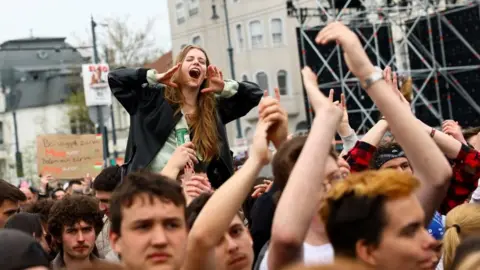
At least 100,000 anti-Fidesz supporters filled Heroes' Square in Budapest on Friday evening
Magyar made a conscious decision not to ally with other parties, choosing to create his Tisza party from the ground up, by creating "Tisza-islands" - often small groups of activists in a sea of Fidesz strongholds. It was not especially original, as Orbán did something similar by forming "citizen circles" during his years of opposition many years before.
But those islands have formed the roots of a national movement and the backbone of his election campaign.
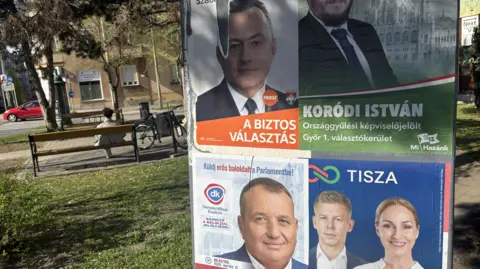
Although other parties are running in the election, only Fidesz and Tisza have significant support
His candidates are not politicians either: they feature surgical specialists, teachers, and business figures who know about their local communities and the problems in Hungarian healthcare and education.
This is not a normal climax to a European election. The two leaders are not taking part in a televised election debate, instead it is being fought on social media and in town squares.
Outwardly Fidesz officials say they remain confident of victory, although political chief Balázs Orbán suggested that if that happens the opposition will not accept defeat.
Ágoston Mráz also voices concerns that Tisza voters will not accept an Orbán victory and will claim there has been election fraud: "I'm really afraid of getting violence on the streets because tension is in the air. I hope very much that every politician will be smart enough to help voters avoid violence on the street."
There was no sign of violence when at least 100,000 Hungarians attended an anti-Fidesz concert in Heroes' Square on Friday night, and Magyar warned people "not to fall for any kind of provocation".




 English (US) ·