
 1 hour ago
5
1 hour ago
5
ARTICLE AD BOX
Frank GardnerBBC security correspondent

 Reuters
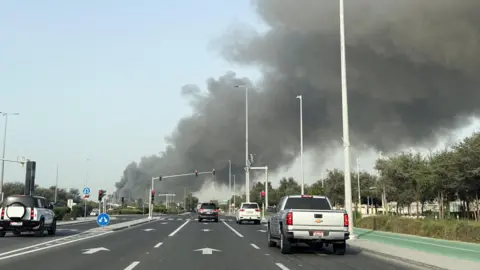
Cities in the Gulf states, like Abu Dhabi pictured here, were not built to withstand attacks from drones and ballistic missiles
In the clear blue skies above Abu Dhabi, white contrails streak high above the sand-coloured villas and well-watered gardens.
These are no incoming Dreamliners or Airbuses bringing in the next manifest of tourists and guest workers. They are incoming ballistic missiles, launched by the Emirates' giant neighbour just across the Gulf: Iran.
As of Sunday afternoon, the United Arab Emirates (UAE) defence ministry said it had so far "dealt with" 165 incoming ballistic missiles, two cruise missiles and 541 Iranian drones.
In Bahrain, a friend alerted me on Sunday morning that the airport was under attack after having a sleepless night.
"Woken by huge bangs and wailing siren," he texted. "I think maybe around 20 booms and bangs. At least two hits".
These are not familiar scenes in this region, but since this conflict began on Saturday morning, Iran appears to have expanded its target set from just hitting military targets, like the US Navy's 5th Fleet headquarters in Bahrain, to airports and other civilian sites.
Now luxury hotels and shopping malls, high-rise apartment blocks, state-of-the-art airport departure terminals are getting sporadically hit as gaps appear in the Arab states' air defences in the Gulf.
These places were never built with the prospect in mind that they would one day come under attack from drones and ballistic missiles.
Video shows debris across floor of damaged Dubai airport
Iran's Foreign Minister, Abbas Aragchi, has denied targeting his country's neighbours, telling Al Jazeera: "We are not attacking our neighbours in the Persian Gulf countries, we are targeting the presence of the US in these countries. Neighbours should direct their grievances to the decision-makers of this war".
Some of the damage to civilian infrastructure in the Gulf states is accidental - resulting from debris falling from intercepted missiles.
The number of attacks on airports in Bahrain and the UAE point to more than coincidence.
Iran always made it clear in advance that, if it was attacked, it would retaliate at any country it considered to be complicit in that attack.
The Gulf states went to some lengths to show Iran they were not part, in their eyes, of this US-Israeli attack.
Yet essentially they have been punished for being long-term military partners of Washington's.
Before the Islamic Revolution, in the days of the shah, Iran was known as "the policeman of the Gulf".
Since the revolution, it has always tried to convince its neighbours that it should resume that role, "taking charge of security" in what it calls Khaleej-e-Fars, the Persian Gulf (Arabs call it the Arabian Gulf).
Iranian leaders have tried, unsuccessfully, to persuade the Arab states in the Gulf to expel the US Navy and adopt them as their guardians instead.
But for rulers of the Gulf states - conservative, dynastic monarchies for whom the revolutionary zeal of the Islamic Republic is anathema - a line has been crossed here.
It is hard to see how they can ever have anything approaching normal relations again with the current Iranian leadership, that is, if it survives this war.
Saudi Arabia and Oman, two countries that have long hosted US and Western military forces, have both escaped a lot more lightly than the other four Gulf Arab states.
Oman, which remains on good terms with the Islamic Republic and was mediating the nuclear talks between the US and Iran, suffered a drone strike on its commercial port of Duqm, down on the Arabian Sea coast.
The Saudi capital Riyadh appears to have been targeted on Saturday, prompting an angry statement from its government.
"The Kingdom of Saudi Arabia expresses its rejection and condemnation in the strongest terms of the blatant and cowardly Iranian attacks that targeted the Riyadh Region and the Eastern Province, which were successfully intercepted. These attacks cannot be justified under any pretext," the statement said.
This is not the first time Iran has attacked its Arab neighbours in the Gulf, either directly or indirectly, but never quite on this scale.
In 2019, an Iranian-backed militia in Iraq launched a volley of drones at Saudi Aramco's petrochemical facilities at Abqaiq and Khurais, temporarily knocking out half of its daily export capacity.
Last June, Iran fired ballistic missiles at the al-Udaid airbase in Qatar but this was seen as a performative response to America's Operation Midnight Hammer air raid that destroyed Iran's nuclear sites at Isfahan, Natanz and Fordo, and Tehran quietly gave advance warning.
Bahrain, which has a large, sometimes restive Shia population, has long accused Iran of funding, training and arming insurgents in its country.
All of this, though, pales compared to the situation the Arab states of the Gulf are now experiencing.
For President Trump, for Israel, for many governments in the Middle East, and of course for many Iranians themselves the best result now would be a swift end to the regime of the Islamic Republic followed by a smooth transition to democracy and a world where Iran can enjoy normal relations with the rest of the world.
That, though, is far from certain.
A race is currently under way by the US and Israel to try to destroy Iran's ability to keep launching these missiles and drones before they can fire them.
For Iran's Revolutionary Guards Corps, the IRGC, the dilemma is whether to surge an attack on a major target like a US warship in the hopes of overcoming its defences, or hold back much of its concealed arsenal in the hopes of outlasting President Trump's patience.
Iran also knows that while it has a finite number of missiles and drones, so, too, are its adversaries constrained by their number of remaining air defences.
If or when those run out before Iran runs out of missiles, drones or launchers then life for those on the ground in the Gulf could be about to get even more alarming.
 Reuters
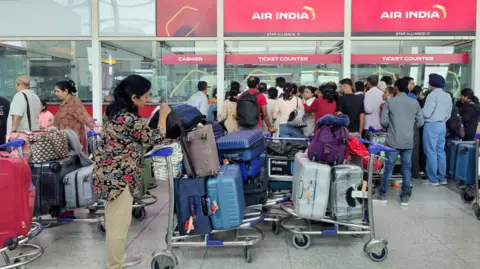
Flights that would have gone over the affected region have been diverted, causing delays
The balance of power is heavily in favour of the US and Israel.
These are two of the world's most powerful and technologically advanced militaries in the world.
There are two US carrier strike groups in the region with over 200 warplanes while Iran, under sweeping sanctions for years, has no air force to speak of.
Both Israel and the US enjoy complete air superiority.
But Tehran still has some things on its side.
The regime, although weakened and unpopular with much of its population, only has to survive to proclaim itself the long-term winner in this conflict.
The Islamic Republic, with its cult of martyrdom, can take a lot more pain than the US can and the longer this conflict goes on the keener President Trump will be to find an off-ramp.
Will the US and Iran return to talks?
If the Iranian regime collapses, that will not be necessary.
But if the regime survives, and it may well, then Washington's triple demands of Tehran will come back into focus, namely: a curb on Iran's suspect nuclear programme, including a return to inspections; an end to Iran's ballistic missile programme; and an end to Iran's support for proxy militias around the region, such as the Hezbullah, Hamas, and the Houthis.
Oman says real progress was being made in talks in Geneva last month on the nuclear file.
But Iran ruled out discussing the other two issues - leading Donald Trump to say he was "not happy with the way the talks are going".
It is possible that back channel contacts could well produce a ceasefire, followed by a return to talks.
But if the two sides' bargaining positions have not moved then military action could well resume.
So this conflict has yet to run its course.







 English (US) ·